Math
Overview
Mathematical computation forms the backbone of quantitative analysis in science, engineering, finance, and data science. This comprehensive library of mathematical functions extends Excel’s capabilities far beyond native formulas, providing access to sophisticated numerical methods implemented in SciPy, NumPy, CasADi, and specialized Python libraries.
Modern mathematical computing requires far more than basic arithmetic—it demands robust algorithms for solving differential equations, fitting complex models to data, optimizing multivariate functions, and performing matrix operations with numerical stability. These functions bridge the gap between Excel’s spreadsheet interface and the power of production-grade scientific computing libraries, enabling researchers and engineers to tackle challenging mathematical problems directly from within a familiar spreadsheet environment.
Calculus and Differential Equations form the foundation for modeling dynamic systems. Whether computing derivatives of multivariable functions through differentiation, evaluating integrals numerically, or solving systems of ordinary differential equations, these tools enable accurate analysis of continuous change. Applications range from sensitivity analysis in optimization to pharmacokinetic modeling in drug development and epidemic modeling in public health.
Curve Fitting and Data Approximation allow you to discover the relationships hidden within data. Using least-squares regression, you can fit symbolic models or pre-defined curves to experimental measurements. This is essential across fields: chemists use adsorption and binding models to understand molecular interactions; biologists apply dose-response and enzyme kinetics models; engineers work with rheological and spectroscopic models. Advanced methods like CasADi-based fitting provide automatic differentiation for complex symbolic expressions, while spline-based interpolation reconstructs smooth curves from scattered or structured data.
Interpolation and Approximation bridge discrete data points with smooth continuous functions. Methods range from simple univariate splines and polynomial interpolation to sophisticated multidimensional approaches like radial basis functions. These are invaluable when you need to evaluate functions at arbitrary points, smooth noisy measurements, or reconstruct surfaces from scattered measurements.
Linear Algebra provides the computational foundation for modern numerical analysis. From matrix decompositions (QR, SVD, Cholesky) to solving linear systems and pseudoinverse computations, these operations underpin virtually every scientific computation. They are essential for solving overdetermined and underdetermined systems, analyzing system stability through eigenvalue problems, and transforming data for machine learning applications.
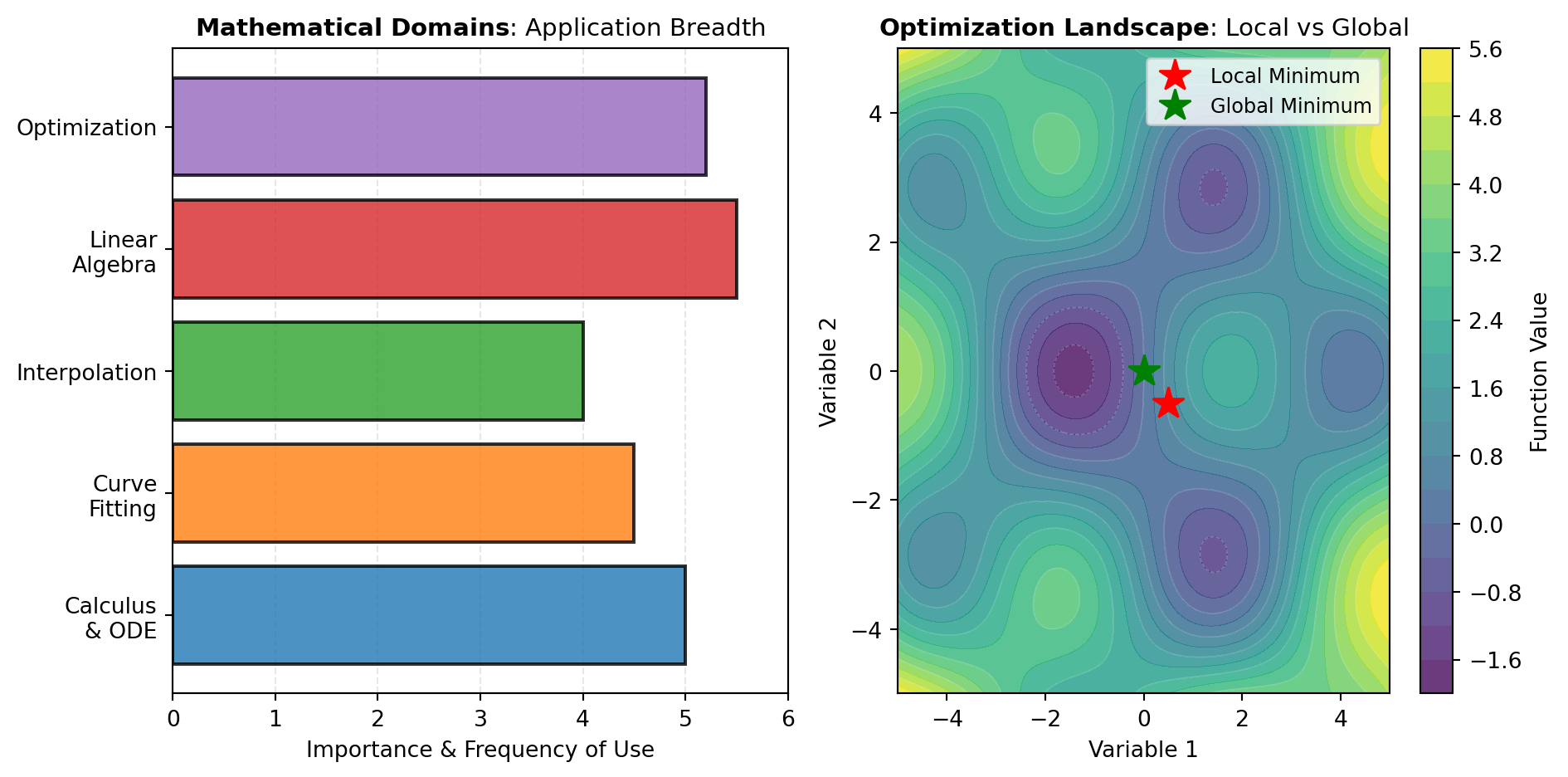
Optimization addresses the central computational challenge: finding the best solution within constraints. Assignment problems like the Hungarian algorithm match resources optimally. Local methods converge rapidly near a solution, suitable when good starting points are available. Global methods like differential evolution and dual annealing explore broader solution spaces to escape local minima. Linear and quadratic programming handle structured problems efficiently, while root-finding tools solve systems of nonlinear equations that arise throughout engineering and science. The reference figure illustrates these key mathematical domains and their interconnections.